Short Summary

Garber Park is a 13-acre wildland park owned by the City of Oakland located behind the Claremont Hotel in Claremont Canyon. Garber Park is home to significant stands of big-leaf maple, California buckeyes and regenerating coast live oak woodland and forest. The Garber Park Stewards vision is to safeguard the native wildland resources of Garber Park while reducing the risk of wildfire and improving the trail system.

Monday, September 2, 2013

                                 CREEK TO BAY DAY in GARBER PARK
                                SATURDAY, SEPTEMBER 21
              MEET AT THE EVERGREEN LANE ENTRANCE 
                        AT 9AM.  WE WILL WORK TILL NOON.


Please join us for our  4th year in participating in the City of Oakland’s Creek to Bay Day.  We will be working along Harwood Creek, pulling invasive weeds that keep wanting to invade this lovely Restoration Site.  The natives are making a tremendous recovery but we need to clear the invasives so we can continue our winter planting later this year.  And for those of you interested in our Trail Project, we will be cutting back ivy out of the trees and along the old trail from Fireplace Plaza to Claremont Ave., and cutting steps in the steepest slopes as we continue the work to make this pathway safe.  

Four years ago the Harwood Creek Restoration Area was covered in Himalayan blackberries and Cape ivy.  Today, the natives are now dominating and include willow, snowberry, thimbleberry, and  milkweed (an important bee pollinator). 

Meet at the Evergreen Lane entrance at 9AM for drinks and snacks before we walk to Harwood Creek to admire the restoration progress and begin our work.
We'll work till Noon.

Wear long sleeves and pants, and shoes with good tread.  Tools, gloves, drinks, and snacks are provided, but do bring your own gloves and water bottle if you have them.

For more information, a map and directions go to www.garberparkstewards.org or contact Bob Strayer rstrayer@2011.nhi.edu.


Monday, July 15, 2013

Help Remove Fire Prone Invasive Weeds


GARBER PARK AUGUST VOLUNTEER WORKDAYS 
 TUESDAY, AUGUST 6
SATURDAY, AUGUST 17
MEET AT THE EVERGREEN LANE ENTRANCE AT 10AM

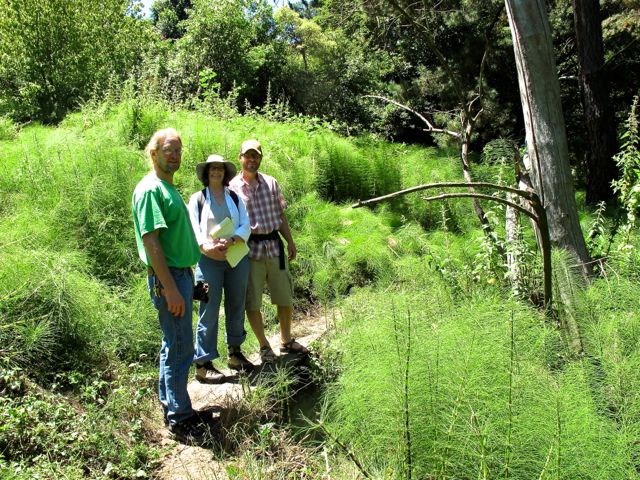
Lech Naumovich, Shelagh Brodersen, and Bob Strayer in
Horsetail Meadow during a recent on-site  GPS planning
meeting.  Bob will be leading the workdays in August
and September.  Thanks Bob
  
Join us in the cool shade of Garber’s native oak woodland as we continue removing fire prone invasive plants and performing maintenance on the Loop Trail.  We will also continue working on restoring the old 1920’s trail from Fireplace Plaza to the parking turn-out on Claremont Ave. 

Our Summer invasive weed pull continues - volunteers have made tremendous progress -  but the hillside at the Evergreen Lane entrance continues to need invasive weed removal, especially above the trail.  Erhardta grass is the main invader here, and needs to be removed to allow the more fire-safe natives to thrive.  The Trail Crew has scoped out the old trail all the way to Claremont Ave.  This trail, which could be an important escape route in the event of a fire, still needs much work before it is usable and we could use your help.  While these tasks are on our steep rugged hillsides, we also have some beautiful flat areas along the Loop Trail needing maintenance to keep the trail open.

Wear long sleeves and pants, and shoes with good tread.
Drinks, snacks, tools, and gloves are provided, but do bring your own gloves and water bottle and gloves if you have them.
Meet at the Evergreen Lane entrance at 10AM.  For a map and directions www.garberparkstewards.org, or contact Shelagh garberparkstewards@gmail.com.

Tuesday, June 18, 2013

Summer Workdays a Success

THANKS to all the many volunteers who have joined us in Garber in June and July to pull and chop invasives, weed the restoration planting beds, and help maintain the Loop Trail.  One hardy group has been scoping out the old 1920's era trail from below Fireplace Plaza to the parking turn-out on Claremont Ave.  Lots more work to do here as they chop through ivy and mounds of eucalyptus duff, but a great start to a difficult job.  

 Volunteers have been rewarded with many blooming flowers.  One of my favorites is Thimbleberry (Rubus parviflorus) which has shown a dramatic re-bound since the WPAD clearing last Summer, was displaying both flowers and berries along the Lower Loop Trail.  These bright red berries are a special treat to many birds.  The Buckeyes were blooming all of June, and the snowberries are just beginning to bloom, and we are starting to see the red fruit of the thimbleberries.  

Creambush (Holodiscus discolor) has beautiful, showy flowers that are just beginning to bloom.
 Not to be missed is the Equisitum in Horsetail Meadows.  Horsetails dominate the meadow from April through early Summer.  


AUGUST WORKDAYS - TUESDAY, AUGUST 6  AND SATURDAY, AUGUST 17
Meet at the Evergreen Lane Entrance at 10AM.  We work till Noon.
For more information contact Shelagh at garberparkstewards@gmail.com.

SAVE THE DATE:  CITY OF OAKLAND'S CREEK TO BAY DAY, SATURDAY, SEPTEMBER 21, FROM 9AM-NOON.  Please join us on this special day where we work at our Restoration site along Harwood Creek.  Details to follow.


Monday, May 27, 2013

SUPPORT THE FEMA EIS AND SCIENCE CONSERVATION


Mounds of flammable duff underneath a eucalyptus
revealed after volunteers removed Algerian ivy
surrounding the tree.  Read Science Behind Eucalyptus
Fire Hazards by Carol Rice for more information 
 As most of us know the Environmental Impact Statement (EIS) for the removal of eucalyptus and other hazardous vegetation in our East Bay Hills has been released for public review.  There were three public hearings conducted by FEMA, which ended Saturday, May 18.   But, you can – and I hope you will – make comments on the plan until June 17.   

The federal grant proposals from the East Bay Regional Park District, University of California, and the City of Oakland are intended to reduce the risk of another disastrous wildfire in the East Bay. The three agencies would cut down the non-native fire hazard trees - mostly eucalyptus, acacia, and pine - in designated areas in our East Bay Hills.  Removing these non-native trees would promote the eventual return of the affected areas to their native habitat.  Of critical importance is the 10 year yearly monitoring period where, according to the FEMA documents, "should success criteria not be achieved at the projected rate, additional adaptive management practices would be implemented to improve progress towards vegetation management goals."  

Recognizing that there is no simple answer to vegetation management in our East Bay Hills I urge you to first read an article recently published in Bay Nature by Dan Rademacher  -  http://baynature.org/articles/east-bay-hills-tree-removal - that is an excellent summary of the issues.  The article’s focus is on Claremont Canyon, the canyon nearest where the 1991 fire began, where Garber Park is located, and where much of the controversy over eucalyptus removal seems to be centered.  The valuable volunteer efforts of Garber Park and others throughout Claremont Canyon is recognized, and Lech Naumovich, who has done so much to advise us and advance our restoration efforts in Garber, is one of four “people with unique perspectives on the place and the plan” interviewed for the article.    

Anyone who was here in 1991 knows the horror of watching the hills burn and knows that it could happen again. We all live through the frightening wildfire potential each fall. Supporting these projects is the best way we know to get rid of these fire hazards. 

Comments are due by June 17, 2013. 
Below are two ways you can help:
1) Write a letter or email the federal emergency management agency (FEMA) and urge them to approve the EIS as is and release the funds.  Send
      *  by email to FEMA at EBH-EIS-FEMA-RIX@fema.dhs.gov
      *  by fax to FEMA (510) 627-7147
      * via mail to FEMA, P.O. Box 72379

2) Sign a petition to FEMA titled " Support East Bay Hills EIS to PROMOTE FIRE SAFETY AND SCIENCE-BASED CONSERVATION.  We did, and urge you to sign the petition also.  Click below for the petition: 

For additional information:

* Read the environmental Impact Report documents:  http://ebheis.cdmims.com/Documents.aspx.  It's a huge document, but I do recommend perusing through it.  Do read the Executive Summary for a description of the grants and the process.  Important to me was Section 5 - Environmental consequences and mitigation.  If you have concerns about herbicides being used and want to know about the management of the areas after implementation plan Section 5 will give you the answers.   

* Claremont Canyon Conservancy, www.claremontcanyon.org.  The Conservancy has been devoted to the cause of science-based prevention of the wildfires that have recurred in and around the canyon for the last hundred years.  It is here you can find sample letters as well as a list of talking points.  Also on their website are several excellent articles:  

*The Science Behind Eucalyptus Fire Hazards. by Carol Rice.  Carol Rice is a fire ecologist and has worked in most of the Bay Area's open spaces with the charge of protecting both ecosystems and human habitats.

*Issues Section,,CCC website: http://www.claremontcanyon.org/issues.php#danswers the most frequently asked questions such as:  Does “species neutral” wildfire risk reduction make sense?  Are eucalyptus trees being scapegoated? Clear cutting NOT recommended.  Absolutely worth reading.

*Costs for Growing Large Eucalyptus Trees will Sky-Rocket by Jerry Kent, Former Assistant General Manager, EBRPD.

*For more on Herbicide use:  Jake Sigg Responds to Citizens' Concerns about Herbicide Use.  An excellent discussion on the science behind the use of the herbicide and how it is applied.  

* Sierra Club Supports the East Bay plan for fire management and native restoration.  Read their letter here.  

FEMA needs to hear from you.  Time for action on this critical issue is now, and your help is critical.

Shelagh and Bob Brodersen

Saturday, May 4, 2013

Restoration Takes a Big Leap Forward with CSEB Environmental Studies Students!


On May 13, the Garber Park Stewards were delighted to host students and their Profeesor, David Larson from an environmental field course at Cal State East Bay.  Led by Mike Vukman, restoration ecologist, this enthusiastic and fun group helped the Garber Park Stewards undertake the first year monitoring of the Measure DD funded Harwood Creek Erosion Control Project in Garber Park.  The CSEB students, under the guidance of long-term volunteer Bob Brodersen, collected all the data, which can now be analyzed so informed long-term decisions can be made to control bank erosion and enhance the beautiful native habitat along Harwood Creek.  Click here to read the report from today’s Measure DD monitoring.

While Bob’s group was tackling the rugged and steep slopes along Harwood Creek, another group continued the effort of invasive plant removal in the restoration area, led by Garber Park volunteer Bob Strayer. This group pulled and dug out Himalaya blackberry roots, poison hemlock, thistle, and an entire field of erhardta grass that was surrounding our newly planted natives.  A truly awesome job.

Thank you Mike and Professor Larson for choosing Garber Park for a hands-on educational experience in watershed restoration.  We truly appreciate your help today – and especially your contributions towards advancing habitat restoration in Garber today.   And special thanks to the two Bob’s for your leadership today.


Next Habitat Restoration Day:  Saturday, May 18, from 10AM to Noon.  Meet at the Evergreen Lane Entrance.  We will turn our attention to Restoration Site 1 at the Evergreen Lane entrance.  This site has seen three successful restoration planting events.  Our natives are thriving, but the invasives are are still trying to take over.  We will once again beat back these invasives, thus ensuring that the less fire prone natives can continue to thrive.

We could also use some help with our caging program.  We are caging baby buckeyes, big leaf maples, and oaks to so they don't become a tasty treat for the deer.

We hope you can join us.  Contact garberparkstewards@gmail.com for more information.
Shelagh for the Garber Park Stewards