Short Summary

Garber Park is a 13-acre wildland park owned by the City of Oakland located behind the Claremont Hotel in Claremont Canyon. Garber Park is home to significant stands of big-leaf maple, California buckeyes and regenerating coast live oak woodland and forest. The Garber Park Stewards vision is to safeguard the native wildland resources of Garber Park while reducing the risk of wildfire and improving the trail system.

Thursday, April 5, 2012

SEVENTH GRADERS MEET NEWTS AND CAPE IVY

For our regular first-Tuesday workday in April, the Garber Park Stewards and our Botanist, Lech Naumovich, were happy to host about 20 Head Royce seventh graders and their instructors,  and happier still to extract from them two hours of labor in the meadow pulling cape ivy.  We set up three work sites with tarps for collecting the pulled stems, and we stood back and let them at it.
They pulled and pulled, found a newt,  pulled some more, and had a contest to see who could pull the longest stem, and pulled some more, and bagged the piles of stems, and carried the bags to our collection point.  


They also found out that the cape ivy in the meadow covered up a lot of things including lots of blackberry plants, both native and Himalayan--they both have thorns--and stinging nettles, and giant vetch which is in bloom right now, and lots of oddly segmented horsetails just high enough now to assess how high they will have to get in order to rule the meadow this summer.  Six feet probably.  In the end 20 Head Royce seventh graders can make quite a dent in cape ivy.  
We had fun, we pulled cape ivy, and we want those seventh graders back for an encore performance. There are still great expanses of cape ivy left to vanquish.
For more pictures click here.

Tuesday, March 6, 2012

Poison Hemlock - Gone


With the help of an enthusiastic group of Japanese students from the English Language Program at CAL Berkeley we were able to remove, by their roots, a hillside of Poison Hemlock.  Why do we need to get rid of poison hemlock? It's a very aggressive and competitive weed that spreads quickly in areas that have been cleared or disturbed.  Once established it prevents establishment of native plants by over shading the area.  We were pleased to find lots of native cucumber, vetch, gooseberries, and ferns in the area.  Thanks to all our volunteers today these natives will have a chance to thrive.


Saturday, February 18, 2012

EARLY SPRING IN GARBER BRINGS DISCOVERIES ON OUR FEBRUARY 18 WORKDAY


Old friends and new friends came to the February 18, 2012 work session.  One of the new friends came with his own weedwrench  which allowed us to uproot major French broom patches near the springs at the head of Harwood Creek [top photo], while others pulled seedling broom from an area which we had cleared two years ago.   We were reminded that maintenance of a cleared area is so much easier than the initial clearing.  It is completely within our grasp to eradicate French broom from Garber Park by the end of this year.
Without meaning to, while working with the weedwrench, Clyde disturbed a juvenile ringneck snake notable for its black and orange markings and notable also just for being present near the upper banks of the creek. Follow this link to see a page of ringnecks, ours is amabilis:  http://www.californiaherps.com/identification/snakesid/ringnecks.id.html   We don't see them often in Garber.
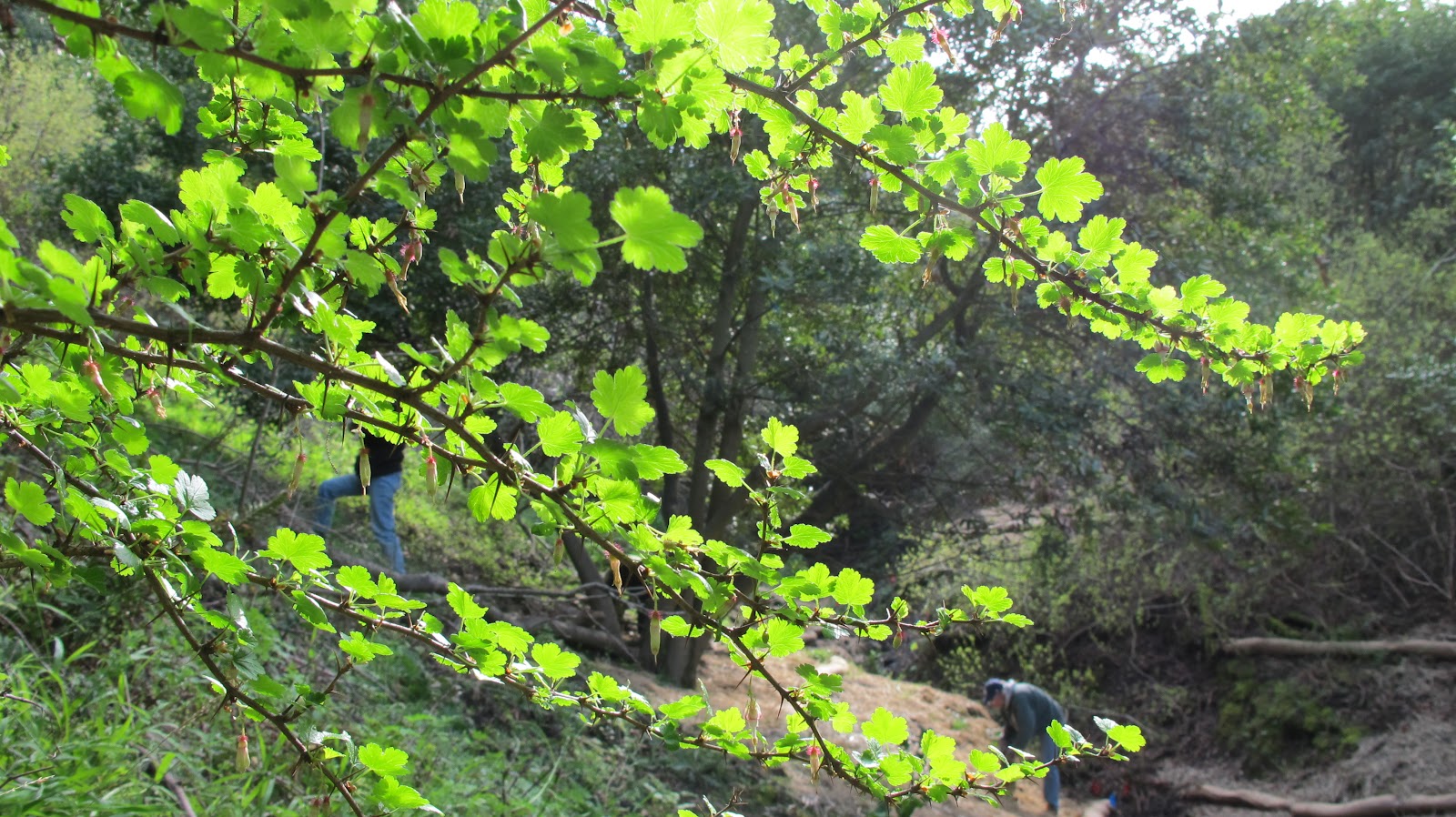
     Discovering things turned out to be the theme of the work session.  Apparently as a consequence of the very wet winter season last year, our forest constituents--particularly coast live oak and California buckeye--produced legions of seedlings.  Because we started working in Garber in draught conditions, we have not seen a spring when rejuvenation of the forests was evident.  But this year seedling trees are everywhere.   In the same vein, the quantity and vigor of native regeneration in areas that we have cleared is surprising.  The gooseberries and currants are far more numerous than we have ever noticed [Ribes californicum, last two photos].
     Finally, we rediscovered an idea that sometimes gets lost--namely that control and eradication of invasive species is in itself an act of restoration.  That is the big picture in Garber Park this spring.  Where we have cleared and either subsequent planting has taken place or simple ground cover has prevented a new crop of weeds, a healthy and energetic native landscape is emerging. This is everywhere evident in the Park.  
     Thanks to our volunteers.  This cannot be done without you!!


Monday, January 30, 2012

MEASURE DD PROJECT COMPLETE!

Erosion control at the former Himalayan Blackberry
Bashing site.  
The past few months have been especially good for Garber Park Restoration efforts:  In December we had a fantastic showing of volunteers to help plant over 200 seedlings in the ground at the Evergreen Lane entrance Hillside.  2012 has begun with many new improvements:  replacement of crumbling steps leading to Fireplace Plaza, and with the recent rains volunteers were able to walk along the Loop Trail and easily pull French broom, vinca, poison hemlock, and other invasive weeds.  We chopped down the eucalyptus re-sprouts near the Loop Trail Junction to Rispin Ln. where a small log has been artfully placed as a resting spot.  We even cleaned up the trash and debris along Claremont Ave.

But, the most notable achievement of the New Year is the completion of the Measure DD Project along the riparian corridor of Harwood Creek.  In 2002 Oakland voters passed Measure DD, a $198.25 million bond measure for better parks and cleaner water. Funded projects include parks, trails, bridges, a recreation center, historic building renovations, land acquisition, and creek restoration.   Garber Park was on the list for funding along Harwood Creek.

The successful completion of this project was a tribute to the collaboration among many groups - Rebecca Tuden, City of Oakland Watershed Specialist, Research and Design Group who designed the project, The Garber Park Stewards, Golden Hour Restoration and other community members who spent countless hours working to achieve a successful project.  And special thanks to Four Dimensions Landscape, who skillfully implemented the project.  

Rebecca Tuden's summary of the work:  The ground was too dry for transplanting many of the species and areas we had discussed. We did the erosion control on the banks, and transplanted riparian species into the toe of the creek (the wet areas in the toe were the only areas we planted). We also replaced the bridge. Finally, we removed non natives near the downstream head cut areas to help the new transplants have light to grow. 

Michael Thilgen's compliments to Garber's volunteersthank you, Garber Park neighbors, for all the conservation work you have done in the park over the years. It's a gem of wildland, and we're honored to have been invited to work there.

Our challenge ahead is to maintain and continue the restoration of this beautiful riparian corridor.  The Garber Park Stewards are excited to lead in these efforts.  We are working with the City of Oakland and Golden Hour Restoration Institute in creating a multi-year Citizen Science Project to monitor and further enhance the native habitat. We will be watching the plants, documenting their growth, and weeding out the invasives to ensure that the new plantings flourish.  Please join us on one of our workdays - the 1st Tuesday and the 3rd Saturday of the month.  Contact Shelagh, garberparkstewards@gmail.com to find out how you can help.  We can't do it without you!


Saturday, January 14, 2012

CLEANING UP CLAREMONT AVENUE


Not many people know that Garber Park has a long border on Claremont Ave.  We Stewards have not spent much time maintaining the section along Claremont – until now, that is.   Last Friday morning we donned our yellow vests and went to work picking up trash along both sides of Claremont Ave. from just behind the Hotel to Alvarado Rd.  In three hours we collected 6 bags of trash, several tires, and some construction debris that had been tossed into the bushes.
                                                               
This clean-up event was an experiment to see if we could safely conduct stewardship sessions on Claremont Ave. With caution and wearing yellow vests we found we could. We now will be offering occasional stewardship days along this beautiful street - Garber Park, with it's steep hillside covered with big leaf maples, buckeyes, and an understory of ferns is at the base of Claremont Canyon and extends almost to Rispin Lane. Unfortunately, ivy still drips from the trees along this section of Claremont Ave., but with the soon to begin Wildfire Prevention Assessment District (WPAD) special project the ivy in the trees will become history.

If you would like to help us monitor conditions along this important thoroughfare please contact us garberparkstewards.blogspot.com.  In the meantime, enjoy this trash-free section of Claremont Avenue.  


Tuesday, January 3, 2012

New Stairs for the New Year

We devoted today's workday to cleaning up the Evergreen Lane Entrance.  Our new plants, with the assistance of "rain" from some sprinklers, are flourishing.  But, the big news is that NEW STAIRS now make walking to Fireplace Plaza a lot safer.   Bob and Ed replaced 8 crumbling steps.  The rest of us weeded, pulled erhardta grass, and cleared the trail.  Please join us at our next workday on Saturday, January 21, where we will continue weeding the Evergreen Ln. entrance,  and begin a seek and destroy campaign against Cape ivy and French broom sprouts.  In the meantime, come and enjoy the new stairs and native planting at the Evergreen Lane entrance.  

Sunday, January 1, 2012

DOGS AND MUSHROOMS DON'T MIX


It is with much sadness that I write this post.  Recently, a most wonderful, happy, playful young dog died from eating poisonous mushrooms in Garber Park.  I put up signs at the entrances to Garber warning people to be careful when walking their dogs during mushroom season – it is wise to keep your dog leashed during the mushroom season. 

Just how common is it for dogs to eat mushrooms?  Responses from people and a google search suggested it is not uncommon.  A few years ago a neighbor’s puppy died from eating mushrooms in her yard.  A local veterinarian suggested that it was common enough that he felt all wildland parks should post signs warning of the danger.  Printed below (originally published in the Monterey Herald, by Karen Ravn) is one of the best articles I found warning that:
                                 DOGS AND MUSHROOMS DON’T MIX.
She was a big, beautiful, healthy German shepherd. But last weekend, without warning, she got terribly sick. He was a small, adorable, healthy Chihuahua. But nearly two weeks ago, without warning, he got terribly sick, too.
In both cases, it was something they ate: mushrooms.

That was the conclusion of the veterinarians who saw the dogs, and it's not a rare diagnosis. "We see one every three months or so," said Jeff Hogans, a veterinarian at the Harden Ranch Veterinary.
But many dogs that get sick from eating mushrooms are probably never seen by veterinarians, said Pat Davis, the veterinarian who handled the Chihuahua's case at the Harden Ranch hospital and was on duty Wednesday at the Monterey Peninsula-Salinas Veterinary Emergency Clinic. "They can end up dying, and the owners never realize what happened."

Neither the Chihuahua's owners nor the shepherd's realized what had happened at first. Neither of them saw their dogs eat mushrooms. But the Chihuahua's owners did see him throw up pieces of mushroom. The Chihuahua's owners were able to get to the hospital in time, and the dog seems to have made a complete recovery.

The shepherd's owners took her to the veterinarian, but they were too late. She died in the car on the way. The owners had an autopsy done to find out what was wrong, and that's how they found out about the mushrooms.

It's never a good idea for dogs to eat raw wild mushrooms any more than it is for people. Some dogs, especially young ones, will eat just about anything.

Dog owners are advised to dig up every mushroom that pops up in their yards -- without mushing them, because that only spreads the spores that will grow more mushrooms.

"Some of the Amanita species especially can be a problem for them," said Lisa Hoefler, director of operations at the Monterey County SPCA. Amanita phalloides, known as the death cap, is the most poisonous mushroom for people.

Cats are at the same risk from mushrooms as dogs, Davis said. Except for one thing: Cats tend to be a lot more finicky about their food.