Short Summary

Garber Park is a 13-acre wildland park owned by the City of Oakland located behind the Claremont Hotel in Claremont Canyon. Garber Park is home to significant stands of big-leaf maple, California buckeyes and regenerating coast live oak woodland and forest. The Garber Park Stewards vision is to safeguard the native wildland resources of Garber Park while reducing the risk of wildfire and improving the trail system.

Monday, October 15, 2012

October Workday Surprises

Berberis Pinnata (Mahonia) an exciting discovery, growing
just below Fire Place Plaza
October's Saturday workday saw a group of Garber's good friends working hard in the area adjacent to Fireplace Plaza where a flight of old stone stairs has just been unearthed, literally.  Because the native complement is rich and includes rarities such as Berberis pinnata, getting rid of the plentiful invasives is a matter of hand pulling.  And we noticed that a whole group of juvenile Buckeyes had survived their first year (a big deal for a baby Buckeye) in positions that restore the continuity of the old Buckeye forest down the hillside.  We selected a few yearlings and caged them against deer-munching,  hoping to insure their success. 
A related task was the inventory and assessment of  Restoration Bed 6 (just above the fireplace) that could tell us which of our plantings had been the hardiest survivors and therefore which natives to consider "matrix" varieties for further restoration planting down the hill.  Here, briefly, is what we found:

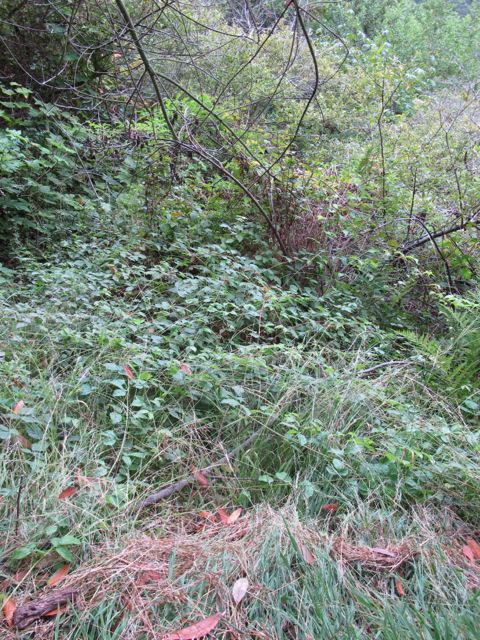
After two years, native blackberry is re-establishing its dominance in many areas of the hillside.  In February 2011 we had scraped the earth inside the beds clean. We deliberately did not plant blackberry.  On its own, it has re-emerged almost everywhere. This is consistent with the undisturbed lower hillside to the west of Fireplace Plaza.  Of the natives that we did plant, however, the most important are a trio of grasses.
Perhaps the hardiest of these, Blue wildrye (Elymus glaucus) has grown and reseeded in many places in and beyond the boundaries of the beds.
Not as energetic, but firmly present nevertheless, California brome (Bromus carinatus) has also reseeded.  In the Fall this annual is spent.  We will be interested to see how quickly it sprouts in the late Winter or Spring.
Replacing the old worn stairs
to Fire Place Plaza.
Common Rush (Juncus effusus) was a mild surprise considering the degree to which it has taken root and thrives in and beyond our beds.  Still clutching its seeds, it stands ready for wetter conditions to release them.  There is a clear crop of yearling Common Rush just beyond the several plants we put in two years ago.  So the conservative strategy of this reed seems to be successful on our hillside.
Among our other planted species both Thimbleberry and Gooseberry seem to be doing well.  False Solomons Seal will probably reappear in the early spring, and our planted native strawberries are lurking under the dry maple leaves with the obvious intention of  expanding their range. 

Tuesday, September 18, 2012

CREEK TO BAY DAY 2012


CREEK TO BAY DAY in Garber Park this year was great!   Under the guidance of Lech Naumovich, Director of the Golden Hour Restoration Institute and valued advisor to Garber Park's several restoration sites, we were able to emphasize and explore the Park's watershed areas and to consider future conservation for this critical wildland feature.  The closer we look at the water in Garber, the clearer its formative role becomes.  But this third annual Creek to Bay Day event in Garber also allowed us to assess larger changes that may be in progress and also the rate and quality of success in our various restoration areas.

WITH A DIVERSE GROUP OF VOLUNTEERS, which at one point included a cohort from Fire Station 7, we walked the Loop Trail in reverse, starting at "Fireplace Plaza"  heading for the creekside restoration area where Measure DD improvements had been carried out.  At creekside, we split up to pull invasives--poison hemlock, re-emerging Himalayan blackberries, Erhardta grass, Cape Ivy--and managed in about an hour to produce more than a dozen tall bags of weeds. On the expanded banks of the creek, to augment the Measure DD plantings in the creek itself,  the Stewards hope to carry out a major restoration planting this winter and spring when the ground is wet and workable. 

 AT THE CREEK we noticed many changes from our first visits three years ago when the entire area was buried under overarching stands of Himalayan blackberries.  Thanks to the "Berry Bashing" contingent of the Stewards the invasive blackberries are gone (a three-year project). And, thanks to Oakland's Measure DD, native and indigenous willows, ash, ferns, and equitsetum (horsetails) have been planted, and the banks are fortified against erosion. Thanks also to the recent WPAD wildfire abatement efforts, large nearby stands of native snowberry, thimbleberry, gooseberry, and ferns have been daylighted.  But perhaps the most interesting and unexpected change is the emergence of hundreds of Oregon Ash seedlings. Some of these native trees are in their second or third year and seem to have withstood deer nibbling.

OUR "PERCHED" OR MIDLAND MEADOW was the secondary destination of Lech's workshop. With a riot of invasive weeds and wetland natives, this large area of seeps and springs--the source of the lower creek--is inappropriate for direct restoration at this time.  Though it is ringed by an upper wall of native willows, the latent native biota is hard to assess and Lech suggested a small experimental area where all foliage would be removed for a period long enough to see what might be in the native seedbed.  We look forward to working with the City of Oakland and Lech for a planting plan that will best advance the unique habitat of this wetlands area of Garber.

THE MEADOW AND ITS CHALLENGES point the way for Garber's future.  The rich diversity and unique beauties of Garber Park are first and foremost the handmaidens of its waterways.   Garber Park IS a watershed and all stewardship relating to its welfare should be informed by that central fact.  It seems like long ago that the Garber Park Stewards recognized that the 13 acres of the park were "worth working for" but the elements and dimensions of that value  remained to be discovered. With friends old and new,  this Creek to Bay Day gave us the opportunity to look deeper, to consider time and perceive change, to notice the interplay of the larger and the smaller elements of Garber's particular environment..

THANKS TO ALL THE VOLUNTEERS who helped make this such a fun Creek to Bay Day.  And special thanks to Lech for leading the tour and opening our eyes.


Wednesday, September 12, 2012

OCTOBER 5 GARBER PARK WILL HOST DR. MATTEO GARBELOTTO'S SUDDEN OAK DEATH TREATMENT WORKSHOP

With Sudden Oak Death confirmed in at least five of our heritage Coast Live Oaks and expecting evidence of further infection, the Garber Park Stewards look forward to hosting the first of Dr. Matteo Garbelotto's five East Bay Field Treatment Training Workshops on Friday, October 5, 2012, at 10 AM to Noon, in the Park's Fireplace Plaza.

In our outdoor setting and speaking to wildland managers, restoration volunteers,  and residential property owners alike, Dr. Garbelotto will address methods for the prevention and spread of the pathogen, present the latest information on SOD, discuss the selection of ideal candidate trees for treatment as well as the factors to consider to insure effective treatment, when and how to treat trees (including live demonstrations of treatments), and also address fire issues such as how and when to protect your home and property from SOD-related risk, when to perform yard work so as not to increase the risk of infection, and how to safely dispose of infected plant material. 

Dr. Garbelotto also recommends that local persons interested in attending this Field Workshop, acquire the regional overview of the advance of the SOD pathogen by attending the Thursday, October 4, 2012 "East Bay SOD Blitz Results" meeting to be conducted from 6 to 7 PM at 159 Mulford Hall, UC Berkeley Campus.  Details, a map, and further information can be found at www.matteolab.com

If you cannot attend the Garber Park meeting, Dr. Garbelotto will present this workshop in other nearby locations as follows:

Tilden Park: Saturday 10/6/12 at 10 AM at the Spillway Picnic Area, near the Lake Anza parking lot

Knowland Park: Saturday 10/6/12 at 2 PM at Knowland Park

Lafayette/Orinda: Sunday 10/14/12 at 10 AM at Community Center, 500 St. Mary's Road, Lafayette, CA

UC Berkeley Campus: Wednesdays 10/17, 10/31 and 11/14/12 under the Big Oak Tree at Tolman Hall Portico (These workshops are free, but registration is required by emailing your name, the date you'd like to attend, and affiliation, if applicable, to Dr. Garbelotto's lab or by calling 510-847-5482.)

Complete information on these workshops is available at www.matteolab.com

 PLEASE PLAN TO ATTEND THIS IMPORTANT WORKSHOP


Sunday, September 9, 2012

CREEK TO BAY DAY IN GARBER PARK


Saturday, September 15, 9AM-Noon:  CREEK TO BAY DAY IN GARBER PARK.
    Join us in our 3rd year of participation in the City of Oakland's Creek to Bay Day. 

Meet at the Evergreen Lane Entrance at 9AM  to sign-in, enjoy some coffee and snacks, and then be ready to walk along the Loop Trail to Harwood Creek for an enjoyable morning of restoration activities.

Our goal:  to remove the invasives that are threatening to encroach on the Measure DD funded Creek Stabilization project along Harwood Creek completed just last January.  

As part of Garber Park's Creek to Bay Day activities Lech Naumovich, Golden Hour Restoration Institute, will be on hand to discuss the importance of Garber's wetlands and the riparian corridor along Harwood Creek.  Learn to identify the unique plant and animal resources that reside here as well as the invasive plants that threaten the survival of this unique ecosystem.

Click here pictures of our first Creek to Bay Day in 2010, where volunteers attacked a 10ft high wall of blackberries, daylighting Harwood Creek.
Click here for 2011 Creek to Bay Day Pictures.  Volunteers completed our Fall Chores, worked with Lech to begin a transect of Harwood Creek, and discovered a new-for-Garber flower, Aster Radulinus.


Wear long sleeves and pants and shoes with sturdy soles.   We provide snacks and drinks,  tools and gloves, but do bring your own gloves if you have them.

Directions:   The nearest address is 144 Evergreen Ln., Berkeley.  From Alvarado Rd., take Slater Lane, then Right onto Evergreen Lane.  The entrance is at the end of the street.

For more information contact Shelagh garberparkstewards@gmail.com or 5100-540-1918.


Friday, August 31, 2012

Fuel Reduction Project Begins....Then Stopped

-->

The long awaited Wildfire Prevention Assessment District (WPAD)  Fuel Reduction Project in Garber Park has begun.  The first phase takes place centrally in the park - to clear flash fuels and ladder fuels for 50 feet on either side of the Lower Loop Trail - basically the path from Rispin, the entire segment of the Lower Loop Trail, and extending through the fireplace area to the ravine just beyond Fireplace Plaza.  This is only phase one, and does not deal with the perimeters of the park (Phase 2).  Phase one deals with any potential ignition that might occur from the trail.
Before WPAD - along the trail.


Along the Lower Loop Trail Garber's major flash fuels are great stands of Erhardta grass, mounds and mounds of Himalayan blackberry, Algerian ivy, and hundreds of dead or brittle limbs extending to the ground from Big Leaf Maples, California Buckeyes, Elderberries, Coast Live Oak, and Bay Laurels.

Before the work began the Garber Park Stewards walked the trail several times, first with Brian, the plant specialist, and Camille Rodgers, City of Oakland Fire Suppression Supervisor.  Then the GP Stewards again walked the trail with Brian and Oscar, the leader of the contract crew who will be doing the work.  Once the work began we were walking the trail and communicating with the crew so they understood exactly what it was they were to remove as well as leave.  

Our task was to figure out how to accommodate the fire safety purpose and at the same time achieve maximum preservation.  Important here was to cordon off native flora - we used yellow caution tape - that we needed to save.  As we discussed each and every inch of ground we discovered that in many areas, especially close to the Rispin side of the park, we found only one or two plants thriving in a sea of Erhardta or Himalayan blackberry.


In the central part of the park we cordoned off entire hillsides of False Solomons Seal, snowberry, various ferns, thimbleberry, Oregon ash, and other natives.  These are healthy and thriving large communities that will provide ample reproductive opportunities, and provide a more fire safe and beautiful understory.


No one will be happier than we will to get rid of the ladder fuels and the flash fuels that drape and hamper the trail, and our entire North Hills Community will be much more fire safe after these ground fuels are removed.
Area along Claremont Ave. still needing flash fuels removed.

Unfortunately, after three days of work in the park in which over half the trail was cleared, work was stopped.  The Hills Conservation Network (HCN) filed a complaint with the City of Oakland.  Deputy Fire Chief Williams stopped work in the park until the matter is resolved.  It is now the end of August and three weeks since the work was abruptly halted. 
Fire season is approaching quickly, and the most critical areas for fire safety, the perimeters of the park (22 homes have backyards contiguous with the park) which includes Claremont Ave., where there are steep pitches with potential chimneys and ravines for flames to race from Claremont Ave. to the interface of the 22 homes on the Southern border.

Near Rispin after WPAD removed flash fuels
We invite you to come to Garber, walk the Lower Loop Trail, and see for yourself the fabulous work that is being done by WPAD to make Garber and our community more fire safe.  If you agree that work should proceed promptly contact Assistant Fire Marshal LeRoy Griffin, lgriffin@Oaklandnet.com or Camille Rodgers crodgers@Oaklandnet.com. 

Wish to know more about the Fuel Reduction Project?  Read a past blog article:
Fuel Reduction Project Takes Another Step Forward:  Here you will find a link to the plan that was submitted to WPAD and a short piece on the Garber Park Stewards Journey to securing the funding for this project.

Contact us at garberparkstewards@gmail.com.


Tuesday, July 24, 2012

OUR THIRD JULY IN GARBER--OLD THINGS AND NEW THINGS

Our July 21st workday in Garber Park brought old friends to challenges, old and new.  As in past Julys, we noticed the approach of Fall in the Big Leaf Maple leaves, this time still lingering on their branches, but browning nevertheless.
On the way to our work site on the lower loop trail, we noticed the pervasive invasion of Erhardta grass on the cool slopes below the switchbacks.  Besides serving as a basic element of a fuel ladder, this exotic  grass proliferates easily and chokes out other plants, including seedling trees.  We decided to clear it from the lower loop trail in the delicious shade of the thimbleberry bushes.  As we worked on the trail we noticed several other early aspects of Fall, including the bright red
Thimbleberries , and the overarching Vicia gigantia, Giant Vetch, which

 had already set seed.  We made a mental note to return and harvest some of the Giant Vetch seed for later scattering in the Measure DD area by the creek.  The Horsetails from the upper meadow are moving into that area and Giant Vetch would thrive there also.
Towering over all of this, we also noticed a blossom that seemed unusual here, though it is not uncommon in East Bay woodlands--Holodiscus discolor known as Creambush or Oceanspray.  Apparently this lovely native is suitable for native gardens and highly regarded as decorative, but we had not noticed it previously among the Snowberries, ferns, Thimbleberries, Gooseberries, and other plants near the creek. 


All this time our special visitor, Janet Gawthrop of CNPS, had been laboring under the low  branches of the Garber Oak to remove outlier Cape Ivy from the high banks of the creek where newly opened spots of sun would invite its spread.  The removal of Cape Ivy remains one of the largest challenges for the Park, especially the wetland areas where it quickly becomes embedded, and has to be removed to the root and carried off site in bags.


 From Janet's vantage, we glanced down into the lower Coast Live Oak forest, so far, we believe, free of Sudden Oak Death infection, but harboring a number of juvenile Bay Laurels, primary vectors for the disease.  In the past Fall has meant a double load of clearing chores, seed collection, and preparation for restoration planting.   This Fall however, facing and searching for a remedial strategy with respect to Sudden Oak Death will take place as a high priority.   Can we keep the lower oak forest in tact?  Can we understand the natural future of each of our distinctive Garber forests? 

Tuesday, June 26, 2012

Summer Weeding

Janet removed Cape Ivy revealing a beautiful
stand of snowberry.
The good news for our first restoration workday of the Summer is that Garber is looking good - all of our plantings over the past two years are thriving, including the Measure DD Project on Harwood Creek.  The bad news - the weeds are also thriving, especially the cape ivy, poison hemlock and Himalayan blackberry.  More good news - we made good progress on the weed eradication front.  Janet attacked the cape ivy near Harwood Creek, uncovering a beautiful stand of native snowberry.  This is definitely an area to continue removing the cape ivy.  John and Clyde made great headway at removing the blackberries that are once again threatening to take over at Harwood Creek.  Sally and Shelagh cleaned up the Evergreen Entrance, Sally raking the steps and cleaning up Fireplace Plaza and Shelagh began weeding the planting beds.  I'll let the pictures tell the story.

Clyde, who usually attacks our biggest broom
in the most difficult spots, went after
Himalayan blackberry today
NEXT RESTORATION WORKDAY:  TUESDAY, JULY 3 @ 10AM.  We will continue weed abatement of the fire prone weeds.  The ground is drying up and fire season is right around the corner.  We hope you can join us.

John attacked the blackberries
at Harwood Creek.


Sally cleared the walkway and
steps at the Evergreen Lane
entrance

And Shelagh spent her time weeding the
restoration beds.