Short Summary

Garber Park is a 13-acre wildland park owned by the City of Oakland located behind the Claremont Hotel in Claremont Canyon. Garber Park is home to significant stands of big-leaf maple, California buckeyes and regenerating coast live oak woodland and forest. The Garber Park Stewards vision is to safeguard the native wildland resources of Garber Park while reducing the risk of wildfire and improving the trail system.

Saturday, May 19, 2012

MAY 19, 2012-MEASURE DD MONITORING-UPPER MEADOW TO MIDDLE CONCOURSE


May 19, 2012--The Garber Park Stewards saved this mid-year workday for a task slightly different than the usual invasive removal chores.  We wanted to take a good look--at the beginning of summer--at the Measure DD plantings along the banks of the middle portion of the creek, mostly for recordation and monitoring purposes.  We were happy to have a couple of seasoned volunteers to help with this sometimes wet job and we were pleased to see our best broom remover, Clyde and his eponymous weed wrench.  This allowed us to do two really necessary things at once.


     Working our way up the creek from the bridge on the lower branch of the loop trail, we were happy to find almost all the red and blue flags that we thought would be there.  The blue flags marked Oregon Ash plantings and the red flags marked willow plantings taken from the stalks of nearby willows.  Altogether we found five Oregon Ash plantings, the tallest of which was a little over four feet; and 15 willow plantings, everyone in good condition, the more shaded ones with a few more leaves.  We were able to measure and photograph each of these.
     While Jon and myself were measuring willows, Clyde went north into the deeper canyon of the creek and came out with a pile of big stemmed French broom which had passed the blooming stage and had set seed.  We will get that pile out on June 5 when the Weed Warriors return to the area to clean up some of the inevitable regrowth in the Measure DD area.

     So we got a lot done, but we owe it to Jon, who turned his car around and came back and reminded us to use the new SOD brush to get the organic matter off our shoes at the end.  IS THERE SOD ON YOUR CLOD?--We are probably the first people to use the brush.  I certainly hope we are not the last.

Mary Millman for
Shelagh and Bob Brodersen--On Vacation!!

Monday, April 23, 2012

CLEAN IT, GREEN IT, MEAN IT: Earth Day 2012 Garber Park


The City of Oakland's Earth Day activities advertised more than 90 sites for folks who wanted to get outside and do some eco-friendly cleaning.  Being a secluded wildland Park, Garber has few mass attractions to offer--mostly at this time of year, a whole bunch of weeds to pull.  So the Garber Park Stewards were delighted to see a motivated turnout from the immediate neighborhood who came for the express purpose of pulling weeds.  By the end of the session, approximately noon, we could say that we cleaned it, we greened it, and from the beginning, we meant it.

In the upper portion of the restoration site at the Evergreen Entrance, we had left one bed unscraped and unplanted with natives.  We called this our control bed and having had 14 months of undisturbed growing time, this area was a complete wall of weeds.   Since the ground was still wet we decided to tackle it, not totally easy in view of the steep grade of the hill.  When we got into it we saw that Erhardta grass was the main offender, but looking deeper we found thistles, broom, forget me nots, poison hemlock, Himalayan blackberry, a few prunus sprouts and NOTHING native--which pretty much proves the point: invasive weeds prevent the establishment of native flora. 

Of course there were some weeds in our native beds as well, but the story there is very good.  Almost everything that we planted over the past year and a half is thriving and reproducing.  The native grasses are notable and will, with very little maintenance, come to dominate the hillside over the next year or two and hold it in place against inevitable erosion.  Even the native strawberries are fruiting.  We were happy to see a large volunteer population of Miner's lettuce in the lower beds, and to our surprise, the reclusive Douglas Iris which we planted in December opened its blossom as the sun shone on it towards noon.   Our labors produced a number of bags of weeds and a re-opened path to the upper beds. We also had an outpost worker with a weed wrench who went to the higher, sunnier elevations and pulled the several broom plants which were lurking in the sunny spots waiting to produce seed.

A small contingent of Earth Day workers got a special pass to avoid weed pulling and to help Bob Brodersen locate and GPS map the oak forest in Garber.   This important knowledge will help us and guide us through the park for next week's Sudden Oak Death (SOD) BLITZ.  On the way to one of the remote sites, they flushed a red fox!! who took off promptly after being disturbed.  Undeterred, Bob and his helpers finished the mapping.  IF YOU WISH TO HELP OUT WITH COLLECTING SAMPLES FOR THE BLITZ, CONTACT US RIGHT AWAY at garberparkstewards@gmail.com.   We know that the infection is present in Garber.  It has the potential to kill a majority of the oaks in Garber Park.  

Click here for more pictures of Earthday in Garber

Saturday, April 14, 2012

Citizen Science Workshop: Sudden Oak Death: Strategies for Facing the Pathogen in Garber Park


On April 7, the Garber Park Stewards were pleased to host a Citizen Science Workshop focused on Sudden Oak Death, presented and led by Lech Naumovich, Ecologist, of the Golden Hour Restoration Institute.

Well-attended by naturalists, arborists, landscapers, trail workers, and interested citizens, the workshop provided in depth instruction and commentary on the current state of research and understanding about the disease. Click here for a PDF of Lech’s excellent 4 page handout on SOD resources.  In some ways more compelling than an update on the research, this workshop provided hands on and eye witness evidence of the existence and the material indicia of SOD infection in the oak forest of Garber Park.

It is one thing to look at photographs of the pathogen and its effects on living forests, but it is quite another to recognize the characteristic bleed of an infected tree right in front of you.  Perhaps counterintuitively, the pathogen slowly and methodically kills an oak tree by girdling the main stem.  Looking directly at this process, you cannot avoid an increasing appreciation of the complexity of the SOD blight in the landscape that surrounds you. Even the ground breaking research of Matteo Garbelotto’s UC Sudden Oak Death Lab does not suggest a strategy for “saving” a forest under attack.

The pathogen itself is a recent (within the last 20 years) stowaway on nursery stock (probably rhododendrons) and within its own biological limits has spread rapidly into Northern California backyards and forests which are evolutionarily unprepared to fend it off.  The bleed on an infected oak is evidence of resistance in the victim, but the functions of immunity are poorly understood to date. The highly vulnerable tan oak forests of Marin County exhibit a mortality rate over 90% while the Coast Live Oaks exhibit only 55% mortality—perhaps due to innate or developing immunity.  Currently available chemical treatments aim to boost the immune response of particular trees in order to save them. But a forest is a great deal more than a de facto gathering of particular trees.

In the complex riparian woodland of Garber Park, each of the four constituent trees (and many shrubs) is affected by the pathogen.  The Big Leaf Maple and the California Buckeye are passive carriers.  The pathogen aggressively feeds on the leaves of the Bay Laurels without killing the tree and the Bay Laurels serve as a vector for the conveyance of the pathogen through the forest.
The Coast Live Oak appears to be an unintended victim and a dead end for the pathogen.  An infected oak has not been shown to transmit the pathogen to another host. Yet, the possible consequence of 55% mortality of Garber’s Coast Live Oaks is a circumstance of great magnitude from every point of view including the loss of mature canopy and fire hazard that would exist from numerous downed heritage oaks.

As the Workshop demonstrated, there are no solutions or prescriptions at this time for “saving” an infected forest, though there may be ways to “save” an infected tree.  Deepening research and increasing experience of arborists may hasten the time when there are proven strategies.  But there are many things we can do now as interested individuals and groups.  We can support the work of the SOD Lab by participating in the upcoming SOD Blitz at the end of April.  The Garber Park Stewards are using the SOD Blitz to better assess the rate and range of infection exhibited by Bay Laurels.  Using a grid system we will collect apparently symptomatic leaves and submit them for testing.  The results will be available in October. 

Sign up now to help with the SOD Blitz 2012 on the weekend of April 28-29 Attend a one-hour long training offered by U.C. Berkeley Dr. Matteo Garbelotto, and then collect symptomatic bay leaves.  Return samples to a drop box at the training site by Sunday evening. To sign up for the UC Berkeley training, go to http://sodblitz2012.eventzilla.net.  To help in Garber Park contact garberparkstewards@gmail.com

We can hone our understanding by recognizing the pathogen and closely observing its operations in Garber Park’s forest.  Phytopthera ramorum is an invader which may become endemic. Whether by direct intervention or more passive strategies,  it behooves us to do as much as we can to spare our native landscape the worst effects of this pathogen.

Thursday, April 5, 2012

SEVENTH GRADERS MEET NEWTS AND CAPE IVY

For our regular first-Tuesday workday in April, the Garber Park Stewards and our Botanist, Lech Naumovich, were happy to host about 20 Head Royce seventh graders and their instructors,  and happier still to extract from them two hours of labor in the meadow pulling cape ivy.  We set up three work sites with tarps for collecting the pulled stems, and we stood back and let them at it.
They pulled and pulled, found a newt,  pulled some more, and had a contest to see who could pull the longest stem, and pulled some more, and bagged the piles of stems, and carried the bags to our collection point.  


They also found out that the cape ivy in the meadow covered up a lot of things including lots of blackberry plants, both native and Himalayan--they both have thorns--and stinging nettles, and giant vetch which is in bloom right now, and lots of oddly segmented horsetails just high enough now to assess how high they will have to get in order to rule the meadow this summer.  Six feet probably.  In the end 20 Head Royce seventh graders can make quite a dent in cape ivy.  
We had fun, we pulled cape ivy, and we want those seventh graders back for an encore performance. There are still great expanses of cape ivy left to vanquish.
For more pictures click here.

Tuesday, March 6, 2012

Poison Hemlock - Gone


With the help of an enthusiastic group of Japanese students from the English Language Program at CAL Berkeley we were able to remove, by their roots, a hillside of Poison Hemlock.  Why do we need to get rid of poison hemlock? It's a very aggressive and competitive weed that spreads quickly in areas that have been cleared or disturbed.  Once established it prevents establishment of native plants by over shading the area.  We were pleased to find lots of native cucumber, vetch, gooseberries, and ferns in the area.  Thanks to all our volunteers today these natives will have a chance to thrive.


Saturday, February 18, 2012

EARLY SPRING IN GARBER BRINGS DISCOVERIES ON OUR FEBRUARY 18 WORKDAY


Old friends and new friends came to the February 18, 2012 work session.  One of the new friends came with his own weedwrench  which allowed us to uproot major French broom patches near the springs at the head of Harwood Creek [top photo], while others pulled seedling broom from an area which we had cleared two years ago.   We were reminded that maintenance of a cleared area is so much easier than the initial clearing.  It is completely within our grasp to eradicate French broom from Garber Park by the end of this year.
Without meaning to, while working with the weedwrench, Clyde disturbed a juvenile ringneck snake notable for its black and orange markings and notable also just for being present near the upper banks of the creek. Follow this link to see a page of ringnecks, ours is amabilis:  http://www.californiaherps.com/identification/snakesid/ringnecks.id.html   We don't see them often in Garber.
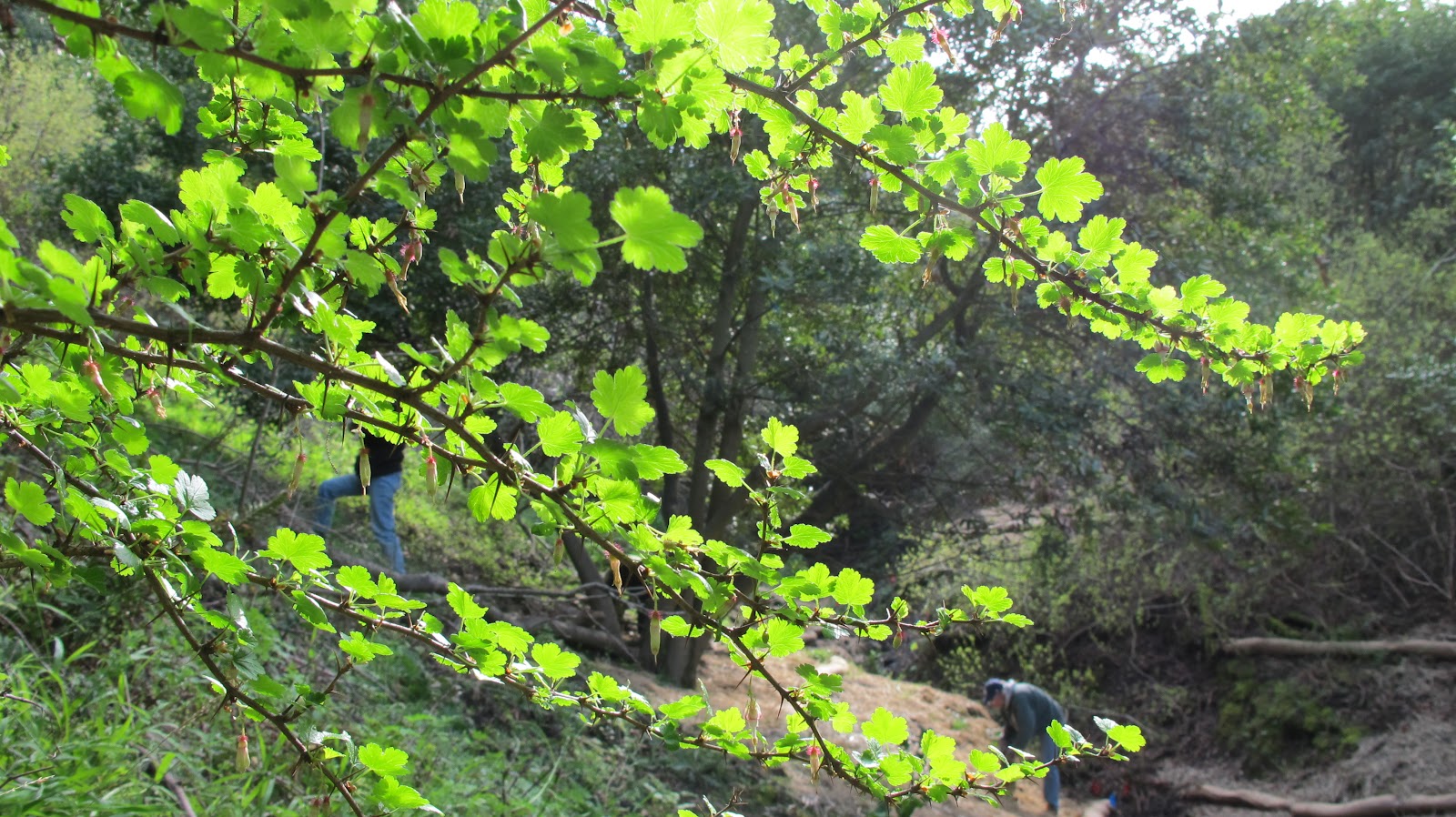
     Discovering things turned out to be the theme of the work session.  Apparently as a consequence of the very wet winter season last year, our forest constituents--particularly coast live oak and California buckeye--produced legions of seedlings.  Because we started working in Garber in draught conditions, we have not seen a spring when rejuvenation of the forests was evident.  But this year seedling trees are everywhere.   In the same vein, the quantity and vigor of native regeneration in areas that we have cleared is surprising.  The gooseberries and currants are far more numerous than we have ever noticed [Ribes californicum, last two photos].
     Finally, we rediscovered an idea that sometimes gets lost--namely that control and eradication of invasive species is in itself an act of restoration.  That is the big picture in Garber Park this spring.  Where we have cleared and either subsequent planting has taken place or simple ground cover has prevented a new crop of weeds, a healthy and energetic native landscape is emerging. This is everywhere evident in the Park.  
     Thanks to our volunteers.  This cannot be done without you!!


Monday, January 30, 2012

MEASURE DD PROJECT COMPLETE!

Erosion control at the former Himalayan Blackberry
Bashing site.  
The past few months have been especially good for Garber Park Restoration efforts:  In December we had a fantastic showing of volunteers to help plant over 200 seedlings in the ground at the Evergreen Lane entrance Hillside.  2012 has begun with many new improvements:  replacement of crumbling steps leading to Fireplace Plaza, and with the recent rains volunteers were able to walk along the Loop Trail and easily pull French broom, vinca, poison hemlock, and other invasive weeds.  We chopped down the eucalyptus re-sprouts near the Loop Trail Junction to Rispin Ln. where a small log has been artfully placed as a resting spot.  We even cleaned up the trash and debris along Claremont Ave.

But, the most notable achievement of the New Year is the completion of the Measure DD Project along the riparian corridor of Harwood Creek.  In 2002 Oakland voters passed Measure DD, a $198.25 million bond measure for better parks and cleaner water. Funded projects include parks, trails, bridges, a recreation center, historic building renovations, land acquisition, and creek restoration.   Garber Park was on the list for funding along Harwood Creek.

The successful completion of this project was a tribute to the collaboration among many groups - Rebecca Tuden, City of Oakland Watershed Specialist, Research and Design Group who designed the project, The Garber Park Stewards, Golden Hour Restoration and other community members who spent countless hours working to achieve a successful project.  And special thanks to Four Dimensions Landscape, who skillfully implemented the project.  

Rebecca Tuden's summary of the work:  The ground was too dry for transplanting many of the species and areas we had discussed. We did the erosion control on the banks, and transplanted riparian species into the toe of the creek (the wet areas in the toe were the only areas we planted). We also replaced the bridge. Finally, we removed non natives near the downstream head cut areas to help the new transplants have light to grow. 

Michael Thilgen's compliments to Garber's volunteersthank you, Garber Park neighbors, for all the conservation work you have done in the park over the years. It's a gem of wildland, and we're honored to have been invited to work there.

Our challenge ahead is to maintain and continue the restoration of this beautiful riparian corridor.  The Garber Park Stewards are excited to lead in these efforts.  We are working with the City of Oakland and Golden Hour Restoration Institute in creating a multi-year Citizen Science Project to monitor and further enhance the native habitat. We will be watching the plants, documenting their growth, and weeding out the invasives to ensure that the new plantings flourish.  Please join us on one of our workdays - the 1st Tuesday and the 3rd Saturday of the month.  Contact Shelagh, garberparkstewards@gmail.com to find out how you can help.  We can't do it without you!