Short Summary

Garber Park is a 13-acre wildland park owned by the City of Oakland located behind the Claremont Hotel in Claremont Canyon. Garber Park is home to significant stands of big-leaf maple, California buckeyes and regenerating coast live oak woodland and forest. The Garber Park Stewards vision is to safeguard the native wildland resources of Garber Park while reducing the risk of wildfire and improving the trail system.

Friday, January 25, 2013

Huge Turnout for MLK Jr. Day of Service and Passive Restoration Workshop


Bagging Cape Ivy and revealing Native Blackberry
 (Rubus  Ursinis), is abundant in Garber and is a
great ground cover that provides habitat.
As I write this post the rain is just beginning, and I smile thinking about our successful Martin Luther King, Jr. Day of Service Event just four days ago that brought over 45 enthusiastic volunteers to participate in our restoration activities along the riparian corridor of Harwood Creek, and how all our new native plants are being nourished by the rain.   We split into two groups, one group went to Harwood Creek along the Lower Loop Trail to participate in a Passive Restoration Workshop lead by Lech Naumovich, Director of Golden Hour Restoration Institute, and the other half climbed up the switchbacks to remove Cape Ivy near Harwood creek along the Upper Loop Trail. 

Harwood Creek has seen many changes since we formed the Garber Park Stewards three years ago.  At our first Creek to Bay Day in 2010, our hardy group of volunteers attacked with gusto a 10-foot high wall of Himalayan blackberries and managed to free part of the creek of this highly invasive plant.  Two years later, thanks to our ongoing “blackberry bashing group,” the blackberries covering the creek are gone. 

Lech demonstrating the propogation
techniques for willows (salix spp), which
grow rapidly and a good choice for
creek stabilization. 
In this area, last January, The City of Oakland completed a Measure DD funded Creek Stabilization Project, in which native and indigenous willows, ash, ferns, and horsetails were planted.  In August, as part of a project funded by the City of Oakland Wildfire Prevention Assessment District, flash fuels and ladder fuels were removed from this section of the park, revealing large stands of native snowberry, thimbleberry, gooseberry and ferns.

A group led by Frank Tsai celebrating President Obama’s Day of Service went after the infestation of Cape Ivy in and adjacent to Horsetail Meadow near the upper bridge on Harwood Creek. After three hours of pulling the ivy out of the trees, shrubs, and meadow and filling 22 bags, the native plants, especially the native blackberry, have a chance to grow.  While there is still much Cape Ivy in the park to keep us busy for a long time a big impact has been made.

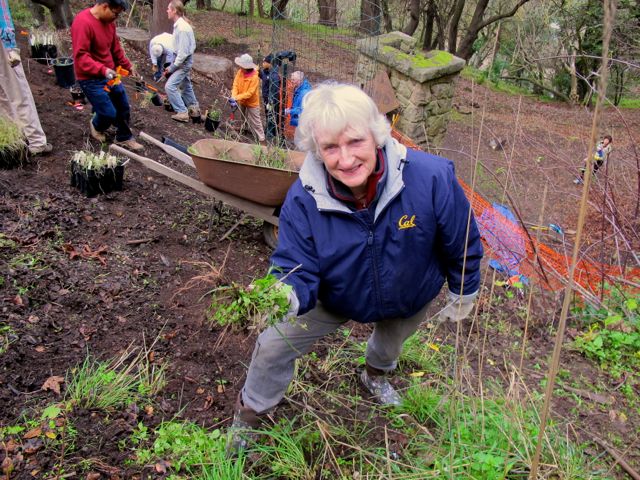
Meanwhile, the other group, lead by Lech, were actively engaged in the Passive Restoration Workshop at the Measure DD area.  Passive restoration uses on-site resources (seeds, vegetation, debris, organic matter) to improve habitat conditions for target native plants.  In Garber, we are very lucky to have well established and thriving colonies of native plants right next to the planting area.  We learned how to “harvest” five native plants that grow in abundance in Garber (California Blackberry, Osoberry, Willows, CowParsnip, and my favorite plant, Thimbleberry), each with its own set of propagation techniques.  Working in teams, we collected and planted across the hillside, finishing by watering and identifying each new plant with a flag. Click here to read more about passive restoration techniques in Lech’s Hand-out Passive Restoration – Ideas andTechniques. 


The joy of finding Osoberry(Oemleria
cerasiformis) among the Cow Parsnips
(Heracleum maximum).
Thank you, Lech, for another informative, hands-on, and FUN workshop. And many, many thanks to the many volunteers who helped us make a huge step forward in transforming this beautiful riparian area of Garber back to its natural state.  We couldn't do it without you.

For more pictures follow the the links below:
Shelagh's pictures
Marilyn's pictures


Saturday, December 22, 2012

Restoration Site 1 - One Week after Planting

Colorful - YES.  Each flag represents a seedling planted
just one week ago.
I was lucky enough to be able to take the opportunity to check out our recent planting at the Evergreen Lane Entrance (click here to read about Saturday's planting) today between the storms.  The hillside is now a colorful array of flags across the hillside.  Last Saturday, just as we were climbing the stairs for the last time, after having successfully planted over 200 seedlings in the ground, it began to rain.  It's been raining off and on (mostly on) all week.

I'm pleased to note that the seedlings and flags appear to be enjoying their new place on the hillside!
Looking through last year's planting to this year's seedlings
to Fireplace Plaza below.  We look forward to watching
the seedlings grow and mature throughout the year.

Wednesday, December 19, 2012

A FUN Day of Planting Natives

Volunteers logged over 75 hours weeding, hauling dirt,
and planting natives during our three day Restoration
Planting Event!
What a fun day!  Lech makes digging in the dirt so much fun!  These are typical comments I've been receiving from the twenty volunteers who helped make our three-day planting event  in Garber an overwhelming success.  "Perfect," said many volunteers.

And a great day it was!  Although the weather was cloudy, there was no rain, which was perfect.  Storms had loosened the soil and made it easy to dig the 200 holes in the ground, which was critical since we were on a steep slope.
Barbara removing invasive
Pigweed from last year's planting.

The weather held until the very end.  As we were walking up the stairs for the last time - a very light mist began.  This was also perfect as the new seedlings received two days of rain to nourish them and aide them in adaptation to their new surroundings.

Safety was our primary concern as we prepared the steep slope for
planting day.  We dug out steps and secured logs across the hillside to act as water barriers and planting platforms.  At the end of the two days of really tough work we surveyed the hillside with satisfaction that the slope was safe.

Bob and Lech securing the logs. 

Everyone climbed the hill with enthusiasm, found their space, and
had a fun morning planting. While most dug holes and planted seedlings, others accomplished the long overdue weeding in last year's planting beds, and still others raked leaves into bags, which were used as the final mulch layer.

We have so many people to thank for our successful restoration efforts over the past three years.  Many, many thanks to the enthusiastic turn-out from the neighborhood and beyond who have volunteered hundreds of hours eradicating invasive weeds, and then joining with us in restoring the unique and valuable native oak woodland habitat. We couldn't have done it without you.

Looking at the fireplace from the trail at the Evergreen
Lane Entrance
Many, many thanks to Lech Naumovich, Executive Director of Golden Hour Restoration Institute, our valued advisor in all our Restoration plantings.  Under his guidance we once again planted over 200 native grasses and shrubs on the Evergreen Lane Hillside, completing our re-vegetation efforts on this steep hillside from above the entrance trail all the way down the hillside to Fireplace Plaza.


Also, many thanks to the City of Oakland for their approval and support, and to Claremont Canyon Conservancy for both their financial support and volunteers.

It's hard to believe that three years ago the Garber Park Stewards first began restoration of the Evergreen Lane entrance by removing a small section of Cape ivy that blanketed the slope.  Throughout the following year volunteers logged over 150 hours hauling debris and removing invasives.  By December the hillside had been transformed into the palette for which the first restoration plan was developed by Lech.  Five beds were created and planted with a variety of native plants and grasses that grow naturally in other parts of Garber Park.  Last year we expanded the successful restoration planting further down the hillside.  We expect this year's groupings of shrubs and grasses, chosen for their ability for soil retention and to prevent erosion, to thrive as well.

Clyde, one of the East Bay's
premier broom bashers, traded his
weed wrench for a trowel.
The Garber Park Stewards will be taking a break for the Holidays. We hope you will find a time to come to Garber to experience the beauty and quiet of this beautiful City of Oakland Open Space wildland park.

Restoration activities will resume in Garber on on Saturday, January 19, from 10AM-Noon.  Lech will guide us in a 
Passive Restoration Workshop and Planting event near Harwood Creek (Restoration Site 2) where the City of Oakland has invested Measure DD funding.  In contrast to our planting at the Evergreen Lane entrance hillside all materials for Restoration Site 2 will originate from onsite.  Come learn about in situ propogation techniques for a number of native plants.  We hope you can join us for another  day of restoration in Garber Park.

To see more pictures of our three-day Restoration Planting event click here.

Monday, November 26, 2012

IT'S PLANTING TIME IN GARBER PARK

We hope you will join us.  Bring family and friends,  and help spread the word.   Click here for a copy of our flyer  to download and share.  

We hope to see you there!

The Garber Park Stewards

Monday, October 15, 2012

October Workday Surprises

Berberis Pinnata (Mahonia) an exciting discovery, growing
just below Fire Place Plaza
October's Saturday workday saw a group of Garber's good friends working hard in the area adjacent to Fireplace Plaza where a flight of old stone stairs has just been unearthed, literally.  Because the native complement is rich and includes rarities such as Berberis pinnata, getting rid of the plentiful invasives is a matter of hand pulling.  And we noticed that a whole group of juvenile Buckeyes had survived their first year (a big deal for a baby Buckeye) in positions that restore the continuity of the old Buckeye forest down the hillside.  We selected a few yearlings and caged them against deer-munching,  hoping to insure their success. 
A related task was the inventory and assessment of  Restoration Bed 6 (just above the fireplace) that could tell us which of our plantings had been the hardiest survivors and therefore which natives to consider "matrix" varieties for further restoration planting down the hill.  Here, briefly, is what we found:

After two years, native blackberry is re-establishing its dominance in many areas of the hillside.  In February 2011 we had scraped the earth inside the beds clean. We deliberately did not plant blackberry.  On its own, it has re-emerged almost everywhere. This is consistent with the undisturbed lower hillside to the west of Fireplace Plaza.  Of the natives that we did plant, however, the most important are a trio of grasses.
Perhaps the hardiest of these, Blue wildrye (Elymus glaucus) has grown and reseeded in many places in and beyond the boundaries of the beds.
Not as energetic, but firmly present nevertheless, California brome (Bromus carinatus) has also reseeded.  In the Fall this annual is spent.  We will be interested to see how quickly it sprouts in the late Winter or Spring.
Replacing the old worn stairs
to Fire Place Plaza.
Common Rush (Juncus effusus) was a mild surprise considering the degree to which it has taken root and thrives in and beyond our beds.  Still clutching its seeds, it stands ready for wetter conditions to release them.  There is a clear crop of yearling Common Rush just beyond the several plants we put in two years ago.  So the conservative strategy of this reed seems to be successful on our hillside.
Among our other planted species both Thimbleberry and Gooseberry seem to be doing well.  False Solomons Seal will probably reappear in the early spring, and our planted native strawberries are lurking under the dry maple leaves with the obvious intention of  expanding their range. 

Tuesday, September 18, 2012

CREEK TO BAY DAY 2012


CREEK TO BAY DAY in Garber Park this year was great!   Under the guidance of Lech Naumovich, Director of the Golden Hour Restoration Institute and valued advisor to Garber Park's several restoration sites, we were able to emphasize and explore the Park's watershed areas and to consider future conservation for this critical wildland feature.  The closer we look at the water in Garber, the clearer its formative role becomes.  But this third annual Creek to Bay Day event in Garber also allowed us to assess larger changes that may be in progress and also the rate and quality of success in our various restoration areas.

WITH A DIVERSE GROUP OF VOLUNTEERS, which at one point included a cohort from Fire Station 7, we walked the Loop Trail in reverse, starting at "Fireplace Plaza"  heading for the creekside restoration area where Measure DD improvements had been carried out.  At creekside, we split up to pull invasives--poison hemlock, re-emerging Himalayan blackberries, Erhardta grass, Cape Ivy--and managed in about an hour to produce more than a dozen tall bags of weeds. On the expanded banks of the creek, to augment the Measure DD plantings in the creek itself,  the Stewards hope to carry out a major restoration planting this winter and spring when the ground is wet and workable. 

 AT THE CREEK we noticed many changes from our first visits three years ago when the entire area was buried under overarching stands of Himalayan blackberries.  Thanks to the "Berry Bashing" contingent of the Stewards the invasive blackberries are gone (a three-year project). And, thanks to Oakland's Measure DD, native and indigenous willows, ash, ferns, and equitsetum (horsetails) have been planted, and the banks are fortified against erosion. Thanks also to the recent WPAD wildfire abatement efforts, large nearby stands of native snowberry, thimbleberry, gooseberry, and ferns have been daylighted.  But perhaps the most interesting and unexpected change is the emergence of hundreds of Oregon Ash seedlings. Some of these native trees are in their second or third year and seem to have withstood deer nibbling.

OUR "PERCHED" OR MIDLAND MEADOW was the secondary destination of Lech's workshop. With a riot of invasive weeds and wetland natives, this large area of seeps and springs--the source of the lower creek--is inappropriate for direct restoration at this time.  Though it is ringed by an upper wall of native willows, the latent native biota is hard to assess and Lech suggested a small experimental area where all foliage would be removed for a period long enough to see what might be in the native seedbed.  We look forward to working with the City of Oakland and Lech for a planting plan that will best advance the unique habitat of this wetlands area of Garber.

THE MEADOW AND ITS CHALLENGES point the way for Garber's future.  The rich diversity and unique beauties of Garber Park are first and foremost the handmaidens of its waterways.   Garber Park IS a watershed and all stewardship relating to its welfare should be informed by that central fact.  It seems like long ago that the Garber Park Stewards recognized that the 13 acres of the park were "worth working for" but the elements and dimensions of that value  remained to be discovered. With friends old and new,  this Creek to Bay Day gave us the opportunity to look deeper, to consider time and perceive change, to notice the interplay of the larger and the smaller elements of Garber's particular environment..

THANKS TO ALL THE VOLUNTEERS who helped make this such a fun Creek to Bay Day.  And special thanks to Lech for leading the tour and opening our eyes.