Short Summary

Garber Park is a 13-acre City of Oakland woodland park located behind the Claremont Hotel. The mile long Loop Trail takes us through a forest of oaks, Bay Laurel, Big Leaf Maples and California Buckeyes to the 1920's era stone Fireplace Plaza. The Garber Park Stewards vision is to safeguard the native wildland resources of Garber Park while reducing the risk of wildfire and improving the trail system.

Saturday, May 4, 2013

Restoration Takes a Big Leap Forward with CSEB Environmental Studies Students!


On May 13, the Garber Park Stewards were delighted to host students and their Profeesor, David Hanson from an environmental field course at Cal State East Bay.  Led by Mike Vukman, restoration ecologist, this enthusiastic and fun group helped the Garber Park Stewards undertake the first year monitoring of the Measure DD funded Harwood Creek Erosion Control Project in Garber Park.  The CSEB students, under the guidance of long-term volunteer Bob Brodersen, collected all the data, which can now be analyzed so informed long-term decisions can be made to control bank erosion and enhance the beautiful native habitat along Harwood Creek.  Click here to read the report from today’s Measure DD monitoring monitoring.

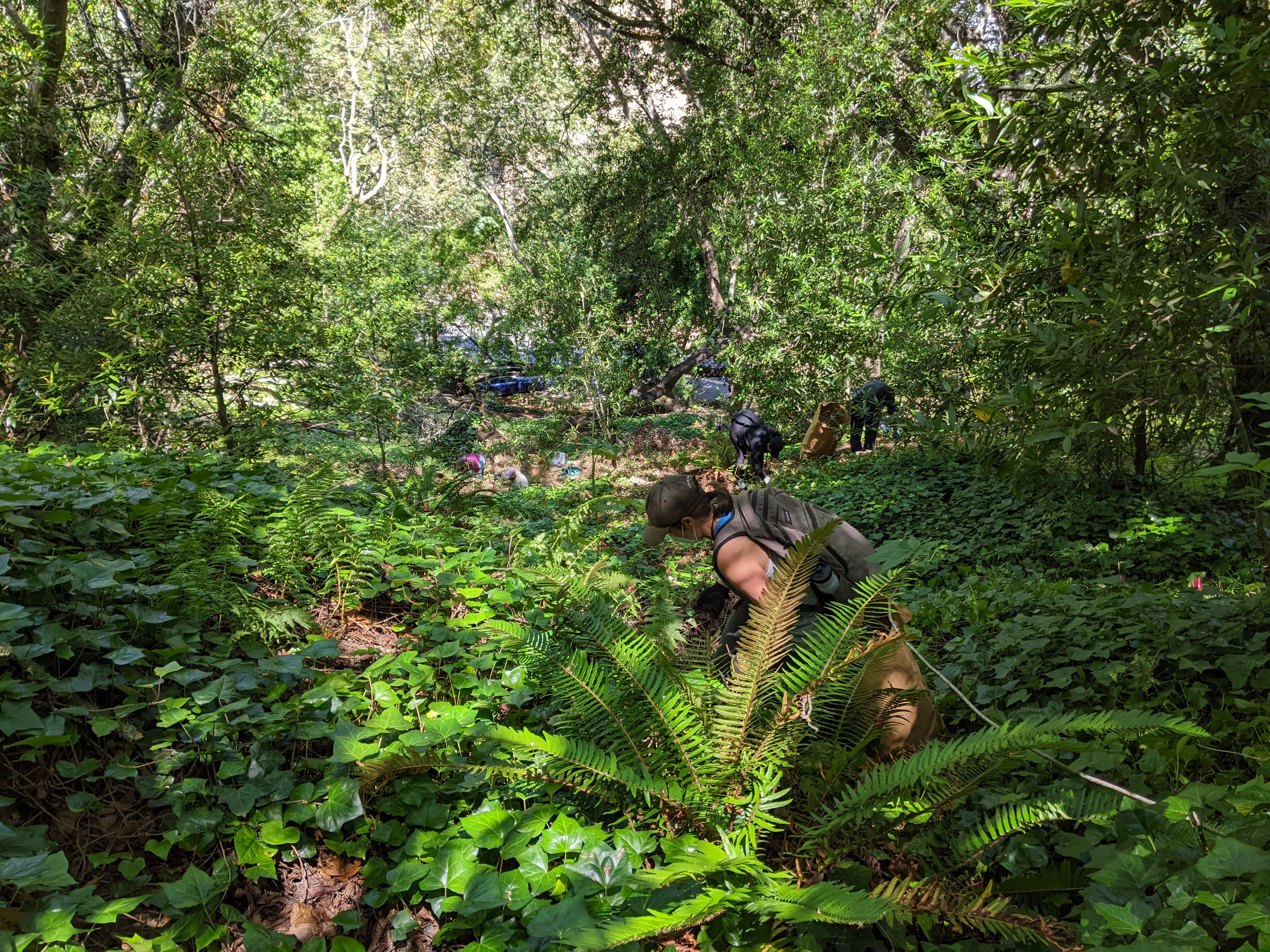
While Bob’s group was tackling the rugged and steep slopes along Harwood Creek, another group continued the effort of invasive plant removal in the restoration area, led by Garber Park volunteer Bob Strayer. This group pulled and dug out Himalaya blackberry roots, poison hemlock, thistle, and an entire field of erhardta grass that was surrounding our newly planted natives.  A truly awesome job.

Thank you Mike and Professor Hanson for choosing Garber Park for a hands-on educational experience in watershed restoration.  We truly appreciate your help today – and especially your contributions towards advancing habitat restoration in Garber today.   And special thanks to the two Bob’s for your leadership today.


Next Habitat Restoration Day:  Saturday, May 18, from 10AM to Noon.  Meet at the Evergreen Lane Entrance.  We will turn our attention to Restoration Site 1 at the Evergreen Lane entrance.  This site has seen three successful restoration planting events.  Our natives are thriving, but the invasives are are still trying to take over.  We will once again beat back these invasives, thus ensuring that the less fire prone natives can continue to thrive.

We could also use some help with our caging program.  We are caging baby buckeyes, big leaf maples, and oaks to so they don't become a tasty treat for the deer.

We hope you can join us.  Contact garberparkstewards@gmail.com for more information.
Shelagh for the Garber Park Stewards


Monday, April 22, 2013

A TOTALLY AWESOME EARTHDAY!!


Removing ivy from the trees and slope along
Claremont Ave.
The Garber Park Stewards and the Claremont Canyon Conservancy were thrilled to see such a tremendous Earth Day turn-out in Garber Park.  The group of 45, consisting of old and new friends from the neighborhood and beyond, including City of Oakland firemen as well as employees and their famiilies from AMEC, an environmental consulting group, were enthusiastic and up for the challenge of pulling invasive weeds on the hilly slopes of Garber.
City of Oakland Firemen from Station 19 in Rockridge
helped at the Claremont Ave site
We split into two groups.  One group attacked the ivy on Claremont Ave. while another group headed to Harwood Creek, removing poison hemlock, Himalayan blackberry, ivy, and thistles from newly planted Restoration Site 2 along Harwood Creek.  No task was too daunting for this energetic group - on Claremont Avenue ivy was attacked with gusto, and because it was the first Ivy Rip in many, many years, the results are quite dramatic.  Our long term goal along this Claremont Ave. corridor?  To rid EVERY tree in Garber of ivy and pull back the ivy from the rich native flora just waiting to emerge.
We were so glad AMEC chose Garber on Earth Day.
Along the Lower Loop Trail and the riparian corridor of Harwood Creek the Earth Day group performed the extremely important task of removing the invasives that were threatening, once again, to take over and smother the newly emerging seedlings.  Crawling up steep hillsides or diving down the hillsides vast quantities of invasives were removed, allowing the natives to flourish and continue to regain their prominence in Garber.

Claremont Avenue before Earth Day.
Claremont Avenue AFTER the Earth Day Weed Pull.


THANKS TO ALL for a fun and phenomenally successful Earth Day.  You made a huge contribution towards native habitat restoration in Garber, a beautiful City of Oakland oak woodland wildland park at the base of Claremont Canyon. 


Click here to see more photos of Earth Day 2013 in Garber 
Marilyn's pictures
Isabella's Earth Day Pictures

Congratulations, Lech!  The Garber Park Stewards share your joy of Earth Day and Golden Hour's most recent awards for your environmental work.   Read more on Golden Hour's blog post 
Happy Earth Day - A Report on Projects, Partners and Awards

Please consider submitting your photos, or sending me a link that I can post on the web.


Saturday, April 6, 2013

Weeding and Wildflowers


Spring Invasive Weed Removal continues to be a success!   Volunteers, young and old, have showed up to lend a helping hand in removing the invasive weeds that seemed to suddenly appear at an alarming rate beginning in February.   The big patches of broom are now gone from Garber -  thanks to Bob and Clyde who showed up with their weed wrenches, searching and removing broom from every corner of Garber.  Many others focussed on removing the huge patches of cape ivy, poison hemlock, and thistle, allowing the horsetails, snowberry, thimbleberry, ferns and other native plants and wildflowers to flourish.  And still others have chosen to do the careful task of weeding our planting beds at the Evergreen Lane Entrance.  Our reward has been one of the best wildflower shows ever in Garber.  We continue to find more Trillium; and Giant Vetch, an annual vine, is popping up all over the park and will soon be blooming.  The field of False Solomon's seal along the Lower Loop Trail is also ready to bloom.   Cow parsnip is waist high - its huge white flowers will soon dominate.  These are just a few of the wildflowers coming into bloom weekly.  It's a beautiful time in the park. 

We all know that pictures are truly “worth a thousand words,” so please click here to see more pictures of our  Spring Invasive Removal Project.

And, if you haven’t seen Lech’s fascinating and fun time lapse video of  our two day planting event in December, click here.  

Monday, March 11, 2013

Trilliums Return to Garber

Trillium chloropetalum (giant wake robin)  

Pulling ivy near the Evergreen Lane Entrance on our 1st Tuesday workday in March we made an exciting discovery – Trilliums in Bloom! Trilliums (Trillium chlorpetalum), or Wake Robin are one of Garber’s most beautiful early blooming flowers. Preferring a shady woodland habitat Trillium provides a true elegance growing among the ferns.  Garber provides the perfect natural habitat for Trilliums but we haven’t seen them for a couple of years. Seen in the past further down the slope towards Claremont Ave, we assumed they had been lost in the thicket of ivy in this western part of the park. 


While Trillium was our most showy and spectacular find, as we removed the ivy we unearthed many ferns (wood ferns, western sword ferns, and licorice ferns), beautiful deep red mushrooms, and Sanicula crassiculus.  Seeing the understory return to this part of Garber, the first area cleared of invasives three years ago is so satisfying and rewarding, and testament to the success of our restoration efforts. 

Now is a great time to come to Garber and take a walk along the Loop Trail as new wildflowers come into bloom each week.  Our next workday is Saturday, March 16 from 10AM-Noon.  We hope you can join us as we continue to push back the invasive weeds.


Monday, February 18, 2013

Invasive Weed Pull a Great Success

After two successful planting days in December and January, it is once again time to turn our attention to eradicating the invasive weeds from Garber.  On Saturday,  our intrepid Broom Bashers managed to pull most of the remaining large stands of French Broom in Garber while the rest of us headed over to the Harwood Creek area and managed to free a large stand of Snowberry,  Osoberry, and currents from Cape ivy that was blanketing the entire slope.
Read more about two of Garber Park's most invasive weeds and you'll understand why we get such satisfaction from removing these habitat destroying weeds:  Cape Ivy, German Ivy (Delairea odorata/Senecio mikanoides) and French Broom (Genista Monspessulana).

On Sunday we were joined by an enthusiastic group of CAL Berkeley students, and we were able to continue the success from Saturday.  In addition to removing Cape ivy and French broom, we were able to cut down eucalyptus sprouts.  Click here to read more about why eucalyptus are considered an invasive weed and fire danger.

Click here for more pictures from our February
Habitat Restoration Days. 

Thanks everyone for a successful weed removal weekend! We hope you can join us in March for  one of our Habitat Restoration Days: Tuesday, March 5 and Saturday, March 16 from 10-Noon.  For more information contact Shelagh garberparkstewards@gmail.com.

Friday, January 25, 2013

Huge Turnout for MLK Jr. Day of Service and Passive Restoration Workshop


Bagging Cape Ivy and revealing Native Blackberry
 (Rubus  Ursinis), is abundant in Garber and is a
great ground cover that provides habitat.
As I write this post the rain is just beginning, and I smile thinking about our successful Martin Luther King, Jr. Day of Service Event just four days ago that brought over 45 enthusiastic volunteers to participate in our restoration activities along the riparian corridor of Harwood Creek, and how all our new native plants are being nourished by the rain.   We split into two groups, one group went to Harwood Creek along the Lower Loop Trail to participate in a Passive Restoration Workshop lead by Lech Naumovich, Director of Golden Hour Restoration Institute, and the other half climbed up the switchbacks to remove Cape Ivy near Harwood creek along the Upper Loop Trail. 

Harwood Creek has seen many changes since we formed the Garber Park Stewards three years ago.  At our first Creek to Bay Day in 2010, our hardy group of volunteers attacked with gusto a 10-foot high wall of Himalayan blackberries and managed to free part of the creek of this highly invasive plant.  Two years later, thanks to our ongoing “blackberry bashing group,” the blackberries covering the creek are gone. 

Lech demonstrating the propogation
techniques for willows (salix spp), which
grow rapidly and a good choice for
creek stabilization. 
In this area, last January, The City of Oakland completed a Measure DD funded Creek Stabilization Project, in which native and indigenous willows, ash, ferns, and horsetails were planted.  In August, as part of a project funded by the City of Oakland Wildfire Prevention Assessment District, flash fuels and ladder fuels were removed from this section of the park, revealing large stands of native snowberry, thimbleberry, gooseberry and ferns.

A group led by Frank Tsai celebrating President Obama’s Day of Service went after the infestation of Cape Ivy in and adjacent to Horsetail Meadow near the upper bridge on Harwood Creek. After three hours of pulling the ivy out of the trees, shrubs, and meadow and filling 22 bags, the native plants, especially the native blackberry, have a chance to grow.  While there is still much Cape Ivy in the park to keep us busy for a long time a big impact has been made.

Meanwhile, the other group, lead by Lech, were actively engaged in the Passive Restoration Workshop at the Measure DD area.  Passive restoration uses on-site resources (seeds, vegetation, debris, organic matter) to improve habitat conditions for target native plants.  In Garber, we are very lucky to have well established and thriving colonies of native plants right next to the planting area.  We learned how to “harvest” five native plants that grow in abundance in Garber (California Blackberry, Osoberry, Willows, CowParsnip, and my favorite plant, Thimbleberry), each with its own set of propagation techniques.  Working in teams, we collected and planted across the hillside, finishing by watering and identifying each new plant with a flag. Click here to read more about passive restoration techniques in Lech’s Hand-out Passive Restoration – Ideas andTechniques. 


The joy of finding Osoberry(Oemleria
cerasiformis) among the Cow Parsnips
(Heracleum maximum).
Thank you, Lech, for another informative, hands-on, and FUN workshop. And many, many thanks to the many volunteers who helped us make a huge step forward in transforming this beautiful riparian area of Garber back to its natural state.  We couldn't do it without you.

Click here for a creative and fun VIDEO of the two-day planting event - two days compressed to 90 Seconds!

For more pictures follow the the links below:
Shelagh's pictures
Marilyn's pictures


Friday, December 28, 2012